
INTRODUCTION
Treating civilian ballistic injuries has become part of the practice of orthopaedic and non-orthopaedic surgeons in the United States. From 2010-2012, over 67,000 patients were injured from a ballistic injury each year, resulting in about $48 billion in medical and work loss costs annually.1 Kaufman and colleagues found an average of 85,694 emergency department visits for nonfatal ballistic injuries from 2009-2017.2 The extremities are frequently involved in nonfatal ballistic injuries, resulting in fractures requiring orthopaedic treatment. From 2001 to 2013, Congiusta et al. reported 334,212 ballistic injuries in which 50% had a fracture.3 Most low-velocity civilian ballistic injuries result in relatively minor soft tissue injuries. However, larger soft tissue injuries can occur, particularly from a shotgun or higher velocity weapons.
Humeral shaft fractures represent about 14% of all fractures to the humerus and 1-2% of all fractures.4–7 Ballistic humerus fractures account for 11% of all ballistic fractures.3 There is a paucity of literature on ballistic humeral shaft fractures. The purpose of this study was to compare outcomes and complications between ballistic and non-ballistic humeral shaft fractures. We hypothesize that civilian ballistic humeral shaft fractures have similar rates of union and infection, but higher rates of neurovascular injury and compartment syndrome compared to those caused by a non-ballistic mechanism.
METHODS
After institutional review board approval, a retrospective review was performed of all humeral shaft fractures treated at a level I trauma center over 10 years (January 2008 to December 2018). International Classification of Diseases 9th Revision (ICD-9) codes 812.00-812.59 and ICD-10 codes S42.3 were used to identify patients with humeral shaft fractures. Inclusion criteria consisted of patients aged 18 years or older treated for an extra-articular humeral shaft fracture at our institution with at least 12 weeks of follow-up. Any patient without at least 12 weeks of follow-up was excluded. Patients were divided into two groups based on the mechanism of injury: ballistic vs. non-ballistic. Ballistic and non-ballistic groups were further subdivided based on initial operative or nonoperative treatment.
Clinical records were reviewed to collect patient demographics, comorbidities, outcomes, and complications. Radiographs were reviewed to classify fracture patterns. Initial operative or non-operative treatment was at the discretion of the treating surgeon, who was either a fellowship-trained orthopaedic hand surgeon or a fellowship-trained orthopaedic trauma surgeon. Fracture union was determined based on radiographic review and clinical exam by the fellowship-trained orthopaedic hand or trauma surgeon. If there was clinical fracture mobility at six weeks, patients were indicated for operative treatment. Failed non-operative treatment was defined as initial non-operative treatment that later required surgical treatment for any reason, at the discretion of the attending surgeon (e.g., patient preference, fracture mobility at 6 weeks). A neurologic injury was defined as absent or decreased function in a discrete motor unit, absent or decreased sensation in a distinct peripheral nerve distribution, or the presence of nerve injury on electrodiagnostic studies. Vascular injuries were diagnosed by computed tomography (CT) angiogram or under direct visualization intraoperatively.
Descriptive statistics were recorded. Statistical analysis was performed using the Wilcoxon signed-rank test for continuous variables and the Fisher’s exact test or chi-square test for categorical variables. The level of significance for all tests was set at P < 0.05.
RESULTS
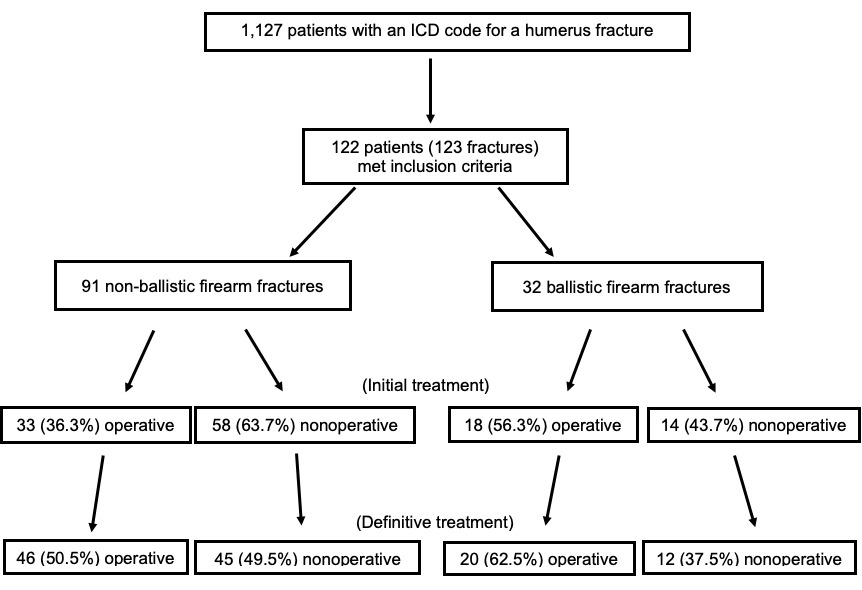
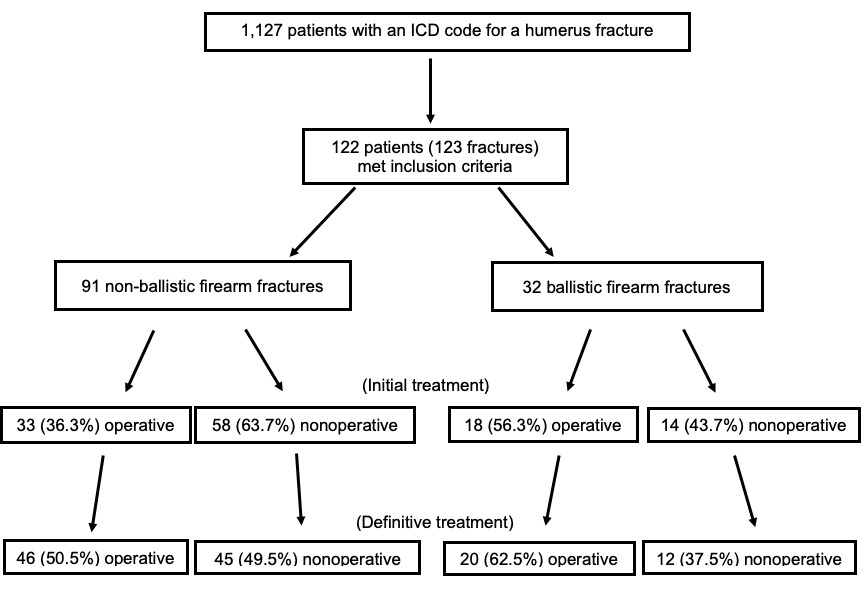
Our initial query resulted in 1,127 patients. After meticulous review, 122 patients met the inclusion criteria with 123 humeral shaft fractures [Figure 1]. There were 32 (26%) ballistic fractures and 91 (74%) non-ballistic fractures. Patients with a ballistic fracture were more likely to be younger (average age in years 27.7 vs 49.9, p<0.01) and male (96.9% vs 39.6%, p<0.01) [Table 1]. Average follow-up was 31.2 weeks, 31.3 weeks in the ballistic group, and 31.1 weeks in the non-ballistic group. A higher proportion of ballistic fractures were initially and definitively treated with surgery compared to non-ballistic fractures [Figure 1]. There was one ballistic injury from a shotgun with a significant soft tissue injury and vascular injury, Gustilo and Anderson grade 3C. All other ballistic fractures in this study had minor soft-tissue injury, which would be considered Gustilo and Anderson grade 1 based on wound size. In the non-ballistic group, there was 1 Gustilo and Anderson grade 3C, 1 grade 3B, and 2 grade 1.
Union
Fracture union occurred in 107/123 (87%) of fractures with no statistically significant difference between the ballistic and non-ballistic group (87.5% vs 86.8%, p=0.88). In fractures treated with initial nonoperative treatment, union occurred in 58/72 (80.6%) with no significant difference between the two groups (85.7% vs 79.3%, p=0.59). Likewise, in fractures treated with initial operative treatment, union occurred in 49/51 (96.1%), with no significant difference between the two groups (88.9% vs 100%, p=0.06). There were two nonunions in the ballistic group that were treated with initial operative intervention. One patient initially treated in external fixation, followed by open reduction and internal fixation, developed an infection two months postoperatively. The infection was treated with surgical irrigation and debridement, and nonunion repair with revision open reduction and internal fixation with iliac crest bone grafting at one year. The second patient required external fixation removal and surgical irrigation and debridement due to an infection and developed an infected nonunion 6 months post-operative. In the non-ballistic group treated with initial surgical treatment, one patient was initially treated with external fixation for a Gustilo-Anderson type 3C open fracture, followed by an intramedullary nail with eventual union. All other patients in this group were treated with index open reduction and internal fixation or intramedullary nail. Patients in the nonoperative group were treated with a fracture brace.
Overall, 92.3% of transverse fractures went to union with initial treatment compared to 86.1% of spiral fractures, 88.2% of short oblique fractures, and 84.1% of comminuted fractures. Comparing comminuted fractures, there was no difference in overall union rates between ballistic and non-ballistic fractures (85.2% vs 82.4%, p=0.84). Comminuted ballistic fractures treated initially nonoperatively had a union rate of 83.3% compared to 66.7% of non-ballistic fractures (p=0.47. Operatively treated comminuted ballistic fractures had a union rate of 86.7% compared to 100% of operatively treated non-ballistic comminuted fractures, p=0.32. Humeral shaft fracture location also did not affect union rates in the initial treatment of ballistic and non-ballistic fractures. Overall, 71.4% of proximal third ballistic fractures went to union with initial treatment compared to 75.9% of non-ballistic fractures p=0.83, middle third 93.3% vs 93.0% p=0.78, and distal third 90.0% vs 89.5% p=0.77.
Failed Nonoperative Treatment
There were 15 (20.8%) patients who failed nonoperative treatment and required surgical fixation due to nonunion (14) or loss of acceptable alignment (1). There was no statistically significant difference between the ballistic and non-ballistic groups for failed nonoperative treatment (14.3% vs 22.4%, p=0.59).
Nerve Injury
Nerve injuries were present in 16 (13.0%) of all fractures, with 11 in the ballistic group and 5 in the non-ballistic group. These injuries were more likely to occur in ballistic fractures than non-ballistic fractures (34.4% vs 5.5%, p<0.01). Four patients in the ballistic group underwent surgery for a nerve injury, including one median nerve repair with sural nerve autograft, one ulnar nerve treated with primary repair, one ulnar and radial nerve neurolysis, and one radial tunnel, carpal tunnel, and cubital tunnel release at an outside hospital. One patient in the non-ballistic group was treated with radial nerve neurolysis and nerve wrap at the time of nonunion repair. All other nerve injuries were diagnosed as neuropraxias and treated with observation and recovered. The radial nerve was the most commonly injured in both groups.
Arterial Injury
Overall, there were 8 (6.5%) arterial injuries, 7 in the ballistic group and 1 in the non-ballistic group [Table 1]. There was a statistically significant difference in arterial injuries between the ballistic and non-ballistic groups (21.9% vs 1.1%, p<0.01). The brachial artery was injured in all cases of arterial injury, and all were treated with a vein interposition graft. All patients with an arterial injury were treated with initial external fixation. A concomitant nerve injury was present in 75% of arterial injuries. All fractures with an arterial injury were described as comminuted, with 1 occurring in the proximal humeral shaft, 6 in the middle, and 1 in the distal humeral shaft.
Compartment Syndrome
No patients in this study were diagnosed with compartment syndrome, either clinically or by compartment pressure measurements. However, 7/8 (88%) of patients with an arterial injury and repair underwent prophylactic fasciotomies.
Early Infection
Infections were present in 7 (5.7%) patients, with 5 (15.6%) in the ballistic group and 2 (2.2%) in the non-ballistic group (p<0.01). The infection rate for patients treated with initial operative treatment in the non-ballistic group was 2/33 (6.1%) compared to 3/18 (16.7%) in the ballistic group. In the ballistic group, two superficial wound infections were treated with oral antibiotics, one draining sinus concerning for infection two years post open reduction and internal fixation, and two deep wound infections treated with surgical irrigation and debridement, both of which had initial external fixation, arterial repair, and fasciotomies followed by open reduction and internal fixation. In the non-ballistic group, there were two deep wound infections treated with surgical irrigation and debridement, one in a Gustilo Anderson Type 3B open fracture and one post-operative open reduction and internal fixation. There were two superficial infections treated with oral antibiotics in the ballistic initially treated nonoperative group and no infections in the non-ballistic initially treated nonoperative group (14.3% vs 0%, p=0.02). Both patients required nonunion repair, with no superficial or deep infection noted at the time of surgery. There were no infections in the 12 ballistic fractures treated with definitive nonoperative treatment. 2/7 (28.6%) of patients who underwent fasciotomy for a ballistic vascular injury developed an infection requiring surgical treatment.
There were 2 (6.3%) postoperative complications in the ballistic group: heterotopic ossification limiting elbow motion and a pin site infection from an external fixator, and 4 (4.4) postoperative complications in the non-ballistic group: 1 deep infection requiring surgery, 1 hardware failure, 1 heterotopic ossification, and 1 radial nerve palsy, which recovered.
DISCUSSION
Humeral shaft fractures can be treated with open reduction and internal fixation (ORIF), minimally invasive plate osteosynthesis, and intramedullary nailing, resulting in various, but overall high, union rates, up to 100% in some studies.8,9 Union rates with nonoperative treatment have been reported to be up to 98% with functional bracing.10 Papasoulis and colleagues reviewed functional bracing and reported an overall union rate of 94.5%, ranging from 77.4% to 100%.11 In a recent meta-analysis of 12 studies comparing operative and nonoperative treatment, operative treatment was associated with fewer nonunions but more deep infections.12 In our study, ballistic humeral shaft fractures had an initial union rate of 87.5%. Our union rate was similar to that reported by Vaidya and colleagues, who reported an overall union rate of 87.0% in 54 civilian ballistic humeral shaft fractures, with initial mode of treatment: 93% in the ORIF group, 67% in the external fixation group, and 86.2% using a fracture brace.13 Similar results were observed in a series of 14 civilian ballistic humeral shaft fractures by Joshi and colleagues: 7 fractures were treated with a fracture brace, resulting in 1 nonunion, and 7 were treated with surgery, with 1 nonunion (85.7% union rate).14 It should be noted that the higher rate of operative treatment in the ballistic group may be due to arterial injuries requiring repair, which are absolute indications for surgery.
Peripheral nerve injury has been reported in up to 1%-18% of humerus fractures.15–17 Radial nerve injury is the most common injured nerve occurring in about 10-12% of all closed humeral shaft fractures.6,15–18 In our study, patients with a ballistic fracture had a significantly Higher rate of nerve injury (34.4%), with the radial nerve being the most commonly injured in ballistic fractures (25%) and in non-ballistic fractures (4.4%) [Table 1]. Higher rates of ulnar and median nerve injuries were also observed with ballistic fractures compared to non-ballistic fractures. Our study had a similar rate of ballistic fracture nerve injury to Vaidya and colleagues, who reported a 37% rate of nerve injury.13 Rates of ulnar and median nerve injury from non-ballistic fractures were similar to those of Noble and colleagues, who reported rates of 2.4% and 1.3%, respectively.15 Bercik et al. reported a peripheral nerve injury in 50% of operatively treated ballistic humerus fractures.19 In a study of 1302 patients with a ballistic injury to the upper extremity, Straszewski et al. identified a nerve deficit in 30% of patients, with the presence of a vascular injury and fracture increasing the rate of neurologic injury.20 Likewise, Pannell et al. reported higher frequencies of nerve palsy in ballistic injuries to the upper extremity with associated fractures, vascular injury, and compartment syndrome.21 Diagnosis and management of peripheral nerve injury following ballistic and non-ballistic humeral shaft fractures remains a challenge. Loewenstein et al. reported initial diagnostic sensitivities for peripheral nerve neurotmesis injury of 54.8% among emergency room physicians, 40.% among trauma surgeons, and 90.9% among upper extremity specialists.22 In a series of 376 patients with humeral shaft fractures and nerve palsy, 91% experienced improvement in nerve function, with an average of 7-9 weeks. The authors of this study recommended nerve studies at that time if there are no signs of nerve recovery.23 Ultrasound may be a useful tool in identifying nerve lesions and nerve continuity even after plate fixation of humeral shaft fractures.24
Vascular injury in the ballistic cohort was 7 out of 32 (21.9%) compared to the non-ballistic cohort of 1 out of 91 (1.1%). This is a higher number compared to that seen in the literature with respect to low-velocity gunshot injuries to the humerus, where vascular injury is %9 - 10.13,25,26 The reason for this discrepancy may be that this specific cohort represents high-energy injuries rather than low-velocity civilian gunshot wounds alone. As mentioned in the results, there was one shotgun injury with extensive soft tissue damage and vascular injury.
Compartment syndrome has been previously reported to occur in 0.6% of all humeral shaft fractures.27 Consistent with our study, Meskey and colleagues reported no cases of compartment syndrome in 110 civilian ballistic humerus fractures.28 Although the risk for compartment syndrome is low, a thorough physical exam to rule it out should be performed in all patients with a humeral shaft fracture.
Various debridement and antibiotic algorithms have been used to treat ballistic fractures. Ballistic fractures with minimal soft tissue injury generally do not require surgical debridement unless otherwise requiring surgical fracture fixation.29 Antibiotics alone, without surgical debridement, have been shown in multiple studies to result in an infection rate of about 2%.30,31 Knapp et al. reported no upper-extremity infections in 58 upper-extremity fractures treated with antibiotics without debridement.30 Likewise, Dickey et al. reported a 2.7% infection rate with no infections occurring in the 26 upper extremity fractures.32 At our institution, ballistic fractures are treated with a first-generation cephalosporin within 24 hours of injury without urgent surgical debridement. Our study showed a 14.3% infection rate of ballistic humeral shaft fractures treated with initial nonoperative treatment and antibiotics alone; however, the 2 infections in this group were superficial and successfully treated with oral antibiotics. Vascular injury and prophylactic fasciotomies may contribute to the increased infection rate seen in operatively treated ballistic fractures in our study compared to non-ballistic fractures. We generally administer a first-generation cephalosporin every eight hours until fasciotomy closure or a wound coverage procedure is performed. Irrigation and debridement with wound closure are routinely performed every 48 hours until all wounds are closed or a soft-tissue coverage procedure is performed. Given the high risk of infection in patients with fasciotomy following vascular injury, additional antibiotic coverage or more frequent irrigation and debridement with wound closure procedures may be considered. Additional studies on infection prevention following fasciotomy for vascular injury are needed.
One weakness of this study is its retrospective nature. The lack of long-term follow-up precludes assessment of neurovascular recovery, true risk of infection, or patient-reported outcomes. Given the minimum 12-week follow-up inclusion criteria, rates of early infection and neurovascular injury could be affected by patients who did not follow up, followed up at an outside institution, or expired shortly after their injuries. Twelve weeks is also generally insufficient to assess healing in these injuries, and patients who may have been healing could have progressed to delayed union or nonunion. However, it is important to note that our mean follow-up was 31 weeks. Also, there was no standard indication for either initial or definitive treatment, as each patient’s treatment was at the discretion of the treating surgeon. Randomized controlled studies comparing specific operative and non-operative protocols for treating humeral shaft ballistic fractures across various fracture patterns and locations are needed.
CONCLUSION
In our patient population, civilian ballistic humeral shaft fractures had fracture union rates similar to those of non-ballistic humeral shaft fractures, regardless of treatment modality. There was also no significant difference in the rate of failed non-operative treatment. Significantly higher rates of neurovascular injury occurred in ballistic fractures, emphasizing the importance of a thorough physical exam and possible further diagnostic studies. No patients were diagnosed with compartment syndrome. Overall, ballistic fractures had a higher infection rate than non-ballistic injuries. The higher infection rate may be due to open wounds from multiple surgeries.
Declaration of conflict of interest
The authors do NOT have any potential conflicts of interest related to the content presented in this manuscript.
Declaration of funding
The authors received NO financial support for the preparation, research, authorship, and publication of this manuscript.
Declaration of ethical approval
Institutional Review Board approval was not required for the production of this retrospective manuscript.
Declaration of informed consent
There is no information (names, initials, hospital identification numbers, or photographs/images) in the submitted manuscript that can be used to identify any patients.