

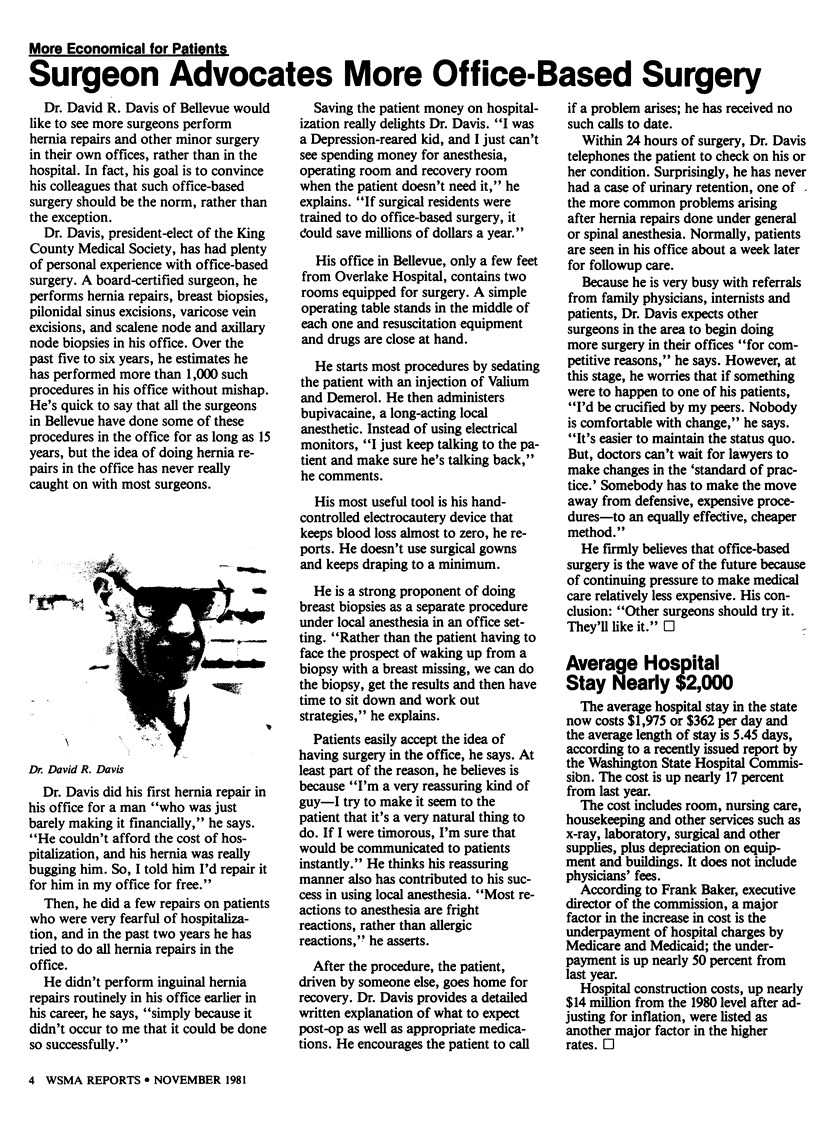

Back in 1981, an article published in the Western Medical Journal shared a surgeon’s effort to convince his colleagues that In-Office Surgery (IOS) should be the norm, not the exception.1 [Figure 1] He also worried that if something were to happen to one of his patients, “I’d be crucified by my peers. Nobody is comfortable with change.” Despite this, he firmly believed that IOS was “the wave of the future… Other surgeons should try it. They’ll like it.” That was 45 years ago. In 1993, the advantages of orthopedic IOS, specifically in-office arthroscopy, were described, emphasizing patients’ ability to view their surgery.2 IOS actually started well before the 80’s. A literature search for “Office Surgery” identifies a 1948 article titled General Anesthesia in Office Oral Surgery.3 Strictly speaking, IOS refers to the venue where surgery is performed and does not specify the type of anesthesia used. The exponential adoption of wide-awake local anesthesia (WALA), which eliminates sedation and general anesthetics, has enabled a wide variety of surgeries to be performed in the office setting and has led to growing interest in and accelerated adoption of IOS. To that end, this piece explores IOS as a WALA venue that does not rely on anesthesia services and the benefits appreciated by its primary stakeholders, Patients and Surgeons.
_4.png)
Patient Perspective: Patients seek effectiveness and convenience. Patients evade unwarranted costs and avoid hospital visits. IOS satisfies these demands and presents a very compelling model of quality, efficient, and effective surgical care. The effectiveness of IOS has repeatedly been shown to be on par with Operating Room Surgery (ORS). WALA enjoys high patient satisfaction, with 94-98% of patients would choose to undergo surgery with WALANT again if needed. Office surgery goes further by eliminating the inconveniences associated with going to the OR. There is no need for intravenous (IV) lines, electrocardiogram leads, oxygen, or changing clothes, all of which are done in ORS regardless of whether surgery is WALA. This explains why 92% of patients report an experience that meets or exceeds expectations. Eliminating preop testing and medical clearance visits saves patients out-of-pocket costs and weeks of prep time. Those are in addition to anesthesia fees. IOS also saves indirect yet very real costs, including lost time, lost income, and transportation costs. With a simplified, better streamlined patient journey and fewer intermediary steps between the decision to proceed with surgery and the surgery itself, patients no longer need to navigate hospital processes and can return home immediately after the procedure. True same-day surgery, when the decision to have surgery, obtaining prior authorization, and completion of the surgery occur in one day, becomes possible. This is particularly valuable when patients live far away and when surgery is urgent yet does not require hospital resources. IOS also saves companion costs, those costs incurred by a companion when ORS is not allowed without someone staying with the patient. Taken together, the above indicate that IOS leads to meaningful decreases in wait times, burden, and cost, as well as improved access to care.
Surgeon’s Perspective: Surgeons seek effectiveness and convenience. Surgeons evade unwarranted costs and avoid hospital bureaucracy. IOS satisfies these demands and presents a very compelling model of quality, efficient, and effective surgical care. Streamlined scheduling, a lighter administrative burden, and the proximity of the surgical suite to the clinic are great time (and psyche) savers for surgeons. Surgeons do not need to change into scrubs in the IOS. There is less patient preparation and charting, so there are fewer delays waiting for others to finish their parts and documentation. The IOS staff is more consistent than the ORS staff due to their focused scope and coverage. This leads to optimal team dynamics and heightened efficiency. Surgeons appreciate the decompression of the OR schedule, reserving it for higher-demand surgeries. IOS can increase surgical volume and allow surgeons to see clinic patients between cases. With fewer scheduling pressures and greater autonomy, surgeons can allocate more time to counseling and shared decision-making and can be available to more patients, improving access to care.
Shared Perspective: Patient-surgeon interactions create an environment that boosts compliance and promotes ownership. Active patient participation improves patient understanding and recovery. Patients can assess the results of their surgery and witness their outcome instantly. This enhances the patient/surgeon relationship, increases satisfaction, and helps identify the potential need for intraoperative adjustments, particularly in situations that require judgment calls or benefit from active testing, such as tendon repairs and transfers, and fracture fixation (i.e., assessing fracture rotation). Surgeons provide feedback instantly including unexpected pathology, or suboptimal conditions. Patients can ask questions about their procedure and are much more attentive to postoperative instructions.
To achieve the above benefits to the greatest extent, appropriate patient and procedure selection is paramount. It is critical to determine that the capabilities and limitations of IOS align with patients’ needs. A history of epilepsy, migraines, fainting, stiffness, chronic pain, and uncontrolled tremors, speech or hearing disability, dementia, severe anxiety, and difficulty following instructions make IOS more challenging and make ORS a safer option.
Small and Bert, back in 2003, recognized that the quality of professional life IOS provides exceeds expectations.4 Describing how a comfortable, surgeon and patient-centered environment that bypasses layers of administrative bureaucracy and expenses, they predicted that many procedures performed in the hospital setting at the time would be done as IOS. Their prophecy proved true to a great extent.